domingo, 5 de septiembre de 2010


sábado, 4 de septiembre de 2010
Monstruos marinos
"Why are the Earth's oceans more mysterious to us than the Moon?"
- Bill Bryson, "A Short History of Nearly Everything"
It's commonly said we know more about the surface of the moon than we know about what happens right here on our own planet, in that murky world at the bottom of the sea. And indeed, we have only explored less than 5 percent of our oceans (we have better maps of Mars than we do of the ocean floor!)
(The Iceland catshark, found off Greenland - image credit National Geographic)
Here's a fun fact for you: did you know that you, an unprotected human being, can last for about two whole minutes in a vacuum -- say on the surface of the moon? Here's another amusing bit of knowledge: did you also know that you, still just an unprotected homo sapiens, would last only the barest smidgen of a second before being totally, completely pulped by the crushing pressures at the bottom of the sea?
There is also more light on the dark side of the moon than there is down, down, down in those ocean depths... One thing we do know, though: even in the deepest part of the ocean, the Challenger Deep in the Mariana Trench, despite the crushing pressure (at least 16,000 pounds per square inch) and the absolute, total, complete darkness, there is life. Auguste Piccard, who made an adventurous trip in 1960 to the bottom of the Deep in his bathyscaphe, the Trieste, saw a few extreme creatures that managed to made that extreme environment their home.
The Fangtooth Fish lives at depths of more than 5,000 meters:

(Bottom: Pacific Viperfish & Vampire Squid - images credit: David Wrobel, National Geographic)
While not as deep – but just as dark – as the Deep, scientists have found, and continue to find, an amazing, and sometimes nightmarish, world of creatures in the abyssal plains, which make up more than a staggering 50% of the earth's surface. 
(Black Dragonfish, image credit: Peter Shearer, National Institute of Water and Atmospheric Research)
Light is so rare down there that its uniqueness is an allure, for mating, as well as a lure, for eating. Grammatostomias flagellibarba, 'dragon fish' to you and I, uses bioluminescence – biological light – mainly for the latter: EATING. Any deep, deep, deep swimmer that notices and becomes interested in a certain tiny flickering light will end up becoming caught by the dragon fish's monstrously huge and needle-sharp toothed mouth. The light being a glowing lure at the end of a long, thin filament connected to the underside of the fish's jaw:
(Scaly Dragonfish, Stomias Boa, image credit: Edith Widder)
The sea angler uses a similar trick, though it's more globular instead of having the dragon fish's lean and nasty body. The angler's lure has the same function, but a different location: its flashing trick is a kind of deadly finger between its eyes and its similarly sharp-toothed mouth rather than being at the end of a thin strand like the dragon fish.
Found two kilometers beneath the Coral Sea, off the shores of Australia - the Hairy Anglerfish: "The long hairs of the anglerfish carry sensory information to the fish's brain":

(image credit: Queensland Brain Institute, via)
The "Longhead Dreamer" anglerfish (Chaenophryne longiceps) was found in waters near Greenland (more info):
(images credit: Peter Rask Møller, National Geographic)
The Bathysaurus, or deep sea lizardfish, can and will bite with any opportunity. It's also a half-a-meter long:

(left: snaggletooth fish; right: barreleye fish, images via 1, 2)
Yet another contender for the oddly pretty prize is the so-called barreleye. This fish takes vision to a new level of spooky strange. Sure, it has eyes, but instead of having to deal with an oh-so-annoying skull that gets in the way of what it's trying to see, the barreleye's head is transparent: to look up it just moves its eyes to focus through its clear – and a bit disturbing – cranium.
(image credit: National Geographic)
Atolla & Periphilla Jellyfish:
(images credit: Queensland Brain Institute, via)
A see-through sea cucumber, Enypniastes, was spotted at depths of about 1.7 miles (2.7 kilometers). It lives in the northern Gulf of Mexico, at depths of 2.7 kilometers (bottom left). On the right is "Dumbo" - with ridiculously big "ears":
(images credit: Census of Marine Life, via)
The Ping Pong Tree Sponge is one of the family of carnivorous demosponges (I bet you read "Demon-sponges, didn't you?) and is pretty big, at least half a meter in height... more info:
(left image credit: Claire Nouvian; right image via)
The granrojo (above right) is not hooked or spiked, but this deep-water jellyfish is just as odd, with chubby arms and an almost plastic looking crimson bell.
While neither of these fish and jellies – and there are far too many to name here – are monsters in size, there is something called abyssal gigantism, the tendency for other forms of extremely deep-dwelling organisms to not only be odd, strange, bizarre and darned creepy but also – yes, you guessed it – HUGE.
Do you have a small dog, a cat, or a larger-than-average tortoise? How would you like to have a pet the size of any of them but isn't just from a different species but from a whole different phylum? 

(image via)
Cute? Not really. Cuddly? Absolutely not. But the giant isopod would certainly be a conversation starter if you took it out for a walk: imagine a pill bug weighing over four pounds.
Other abyssal giants include the poster child for arachnophobia, the Japanese spider crab, which averages 12 feet from leg to creepy leg; and then there's the giant ... well, we'll get to him in a minute.

(images via 1, 2)
Vampire Sea Spider from Antarctica? Sounds like something from H.P.Lovecraft's "At the Mountains of Madness", but it is a real creature, not a fantasy (more info) -
(image via)
While not a heavyweight, one of the most oddly lovely creatures living in the dark depths is the very-correctly named vampire squid. Blood red, with soft hooks instead of a squid's regular suckers, it has the neat trick of flipping it's legs over its soft body turning itself into a spiny ball. The vamp has its own bioluminescent trick as well: glowing when it wants to be seen but turning its lights off when it wants to vanish into the darkness.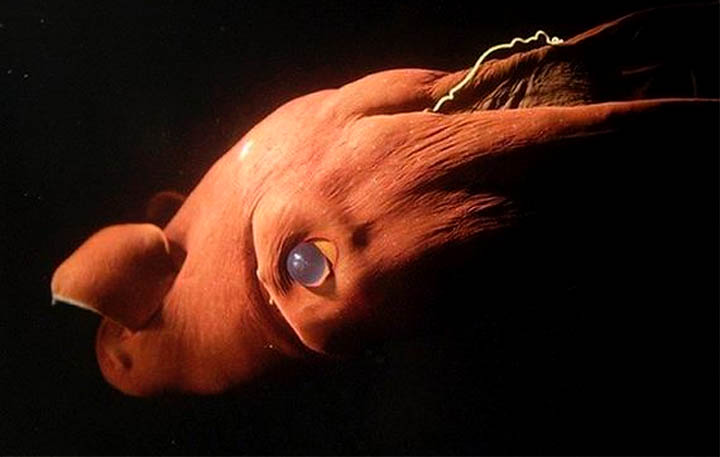

(images via 1; David Shale, 2)
We could go on, and there are certainly more than enough odd and strange and weird and beautiful and disturbing creatures out there, but it has to be mentioned that while we know about some, there are still possibly thousands of even odder, stranger, weirder, more beautiful and disturbing creatures in the deep seas.

(images via 1, 2; art by Bob Eggleton)
Remember the promise about getting back to one particular example of abyssal gigantism? Well, there is one creature that is a mix of the known and the unknown, exemplifying the wonder, and horror, of the dark oceans. For a long time it was thought it was just a myth, a story shared by sailors who'd been out at sea too long. But then there was evidence: the disturbing marks on the sides of Sperm Whales, the kings of the sea -- evidence of nightmarish battles between one and the other miles below the surface.
(images via 1, 2)
These giants are out there, possibly the largest species currently on the planet: eyes the size of dinner plates, 30 foot tentacles dotted with razor-toothed suckers, and a massively strong beak. Architeuthis, the giant squid to you and I, was recently filmed for the first time but there is still much – too much – we don't know about it.
So take a moment and look up at the stars and the moon, wonder about the mysteries that may be up there, but then go to the shore, look out at the sea, and think that we may very well know more about a hunk of rock 250,000 miles away than we know about a world full of life just a few miles away, and many lightless miles straight down.
domingo, 29 de agosto de 2010
Jay-Z and Beyonce Charter $40 Milllion Superyacht
de Luxist de Jared Paul Stern
Add another famous couple to The Classicist's list of superstars (including Madonna and Brangelina) sunning themselves on superyachts this summer: Jay-Z and Beyoncé. R&B's royal couple have been cruising on the French Riviera on a $40 million superyacht, the London Daily Mail reports. The pair, who earned an estimated $150 million between them last year, are chartering the 180-ft. Altitude (above), built by Italy's Benetti yachts in 2003, for $370,000 a week. The yacht can accommodate 14 guests in 6 cabins. The vast split-level owner's apartment has his and hers white marble bathrooms, a separate study and a private 180º raised observation lounge with spectacular views forward. A sun deck features a huge spa pool complete with wetbar and a well equipped gymnasium. The yacht is also available for sale at about $40 million.

Gallery: Jay-Z and Beyonce's Superyacht Charter


Pedrosa completa otro triplete español al ganar en Indianápolis

Dani Pedrosa (Honda) completó el octavo triplete español en la historia del Mundial de Motociclismo al imponerse en el Gran Premio de Indianápolis de MotoGP.
El líder del campeonato, el español Jorge Lorenzo (Yamaha), cruzó la meta en la tercera plaza por detrás del estadounidense Ben Spies (Yamaha), con el que el año que viene compartirá equipo, y por delante del italiano Valentino Rossi (Yamaha).

Lorenzo lidera el campeonato con 251 puntos sobre 183 de Pedrosa; 126 del italiano Andrea Dovizioso (Honda); 119 del australiano Casey Stoner (Ducati), 114 de Rossi; 110 de Spies; y 109 del estadounidense Nicky Hayden.

En la carrera de 125 c.c. se impuso Nico Terol (Aprilia) y en la de Moto2 Toni Elías (Moriwaki). Con la victoria de Terol, el motociclismo español supera con 23 el récord de triunfos en grandes premios en una temporada.
Hamilton gana y lidera el Mundial
Webber sale mal y acaba segundo; mientras que Alonso abandona a falta de seis vueltas tras un accidente.- Una sanción aparta a Alguersuari de los puntos, mientras De la Rosa concluye 12º
Aún sin tener el mejor coche, Lewis Hamilton consiguió una nueva victoria. No había sido el mejor en ninguno de los entrenamientos previos a la carrera de Spa Francorchamps y, sin embargo, logró realizar una buena clasificación, partió segundo en la parrilla, y en el comienzo de la carrera fue quien mejor la inició. La carrera de Hamilton fue impecable desde el inicio, cuando un error de Mark Webber -sus ruedas patinaron-, le permitió a él, a Kubica y a Button colocarse en las tres primeras posiciones, mientras que el australiano quedaba relegado al quinto lugar.


La carrera tuvo un componente de locura, como suele ocurrir en Bélgica, con agua en la pista, con lluvia intensa en algunos momentos, con accidentes y con la presencia del coche de seguridad en varias ocasiones. Para Fernando Alonso la carrera fue un auténtico suplicio. La comenzó mal, porque se equivocó ya en la clasificación al exigir que rectificaran su puesta a punto para colocar una configuración de agua, ya que las previsiones señalaban que se correría en estas condiciones. Y después la prosiguió con errores de peso del equipo, porque en la tercera vuelta, cuando cayeron las primeras gotas, le llamaron al taller para cambiar neumáticos y colocar los intermedios. Sólo dos vueltas más tarde tuvo que entrar de nuevo para colocar los neumáticos de seco.
Todo ello le costó caro. Y a pesar de todo logró colocarse en zona de puntos. Iba octavo en la vuelta 38º cuando, con intermedios y una lluvia intensa, pisó la línea blanca que delimita la pista y perdió el control del coche. Chocó contra el muro y rompió la suspensión delantera, dejando el coche tirado en medio de la pista. Fue un cúmulo de errores, que pueden costarle caro de cara al campeonato del Mundo. Básicamente, porque sus grandes rivales para el título se equivocaron menos y cogieron buenos puntos.
Hamilton, Button y Kubica no entraron al principio a cambiar neumáticos y pudieron mantener sus posiciones cuando el coche de seguridad entró por primera vez como consecuencia de un incidente entre Barrichello y Alonso, que dejó varios elementos del coche del brasileño en la pista. La lluvia arreció rápido y la carrera prosiguió sin grandes incidencias, hasta que Sebastian Vettel intentó adelantar a Button por la segunda posición en la 17ª vuelta. El alemán perdió el control de su coche y envistió directamente al británico, obligándole a abandonar. Vettel fue sancionado con un drive-through y perdió todas sus opciones. Pero Button se quedó sin 18 puntos que tenía casi asegurados.
El incidente benefició a Webber y Kubica. La carrera, sin embargo, acabó de definirse con la llegada de la última tanda de lluvia, a falta de 10 vueltas. Hamilton, Kubica y Webber, que dominaban la carrera por este orden, esperaron una vuelta en entrar en boxes y eso pudo costarles caro: Hamilton sufrió una salida de pista y estuvo a punto de estamparse en el muro, y Kubica se pasó de frenada en el pit lane y perdió la segunda posición en beneficio de Webber. Después vino el accidente de Alonso, la salida de De la Rosa cuando iba décimo, y el ascenso de Alguersuari hasta la décima posición, aunque los comisarios le impusieron una sanción de 20 segundos por un roce con Liuzzi que le priva de los puntos.
Hamilton ganó la carrera y alcanzó así el liderato del Mundial, que domina con 182 puntos. Webber pagó sus errores y es segundo, con 179 puntos, seguido de Vettel, con 151, Button, 147 y Alonso, 141. Los más perjudicados, Button, Alonso y Vettel, que no puntuaron.
sábado, 28 de agosto de 2010
Globos terráqueos
"Your Very Own Slartibartfast Planet Factory" - Stuart Witts
With Google Earth you can explore and visualize our planet's surface on your flat laptop screen in minute detail, but it is still only flat... No sublime roundness to touch, no curves to trace, or even admit it, if you are an Earth lover - no Earth to hug. Globes allow you to hug the Earth (not to mention providing us with the most accurate and educational info).
Recently here at Dark Roasted Blend, we took a look at the unusual maps of various parts of the globe. This time, we thought we’d examine some of the more unusual depictions of the Earth itself.
Powered by a computerized sensor and an electromagnet, this striking globe seems to actually levitate in the air with no visible means of support (below left). The massive globe in Savannah Georgia (below right) is actually a decorated natural gas tank:

(images via 1, 2)
These huge globes can be purchased (for around $40,000) or rented from here:
(images via)
The Mapparium at the Mary Baker Eddy Library in Boston (more info) is a three-story glass globe turned inside out, so you can view it from the inside. It shows the world as it was in the 1930’s, including the USSR and European colonies in Africa and Asia:
(images via 1, 2)
Vintage Globe Architecture
This photograph from the 1930’s shows the large globe in the Daily News building in New York City:
(image via)
Not really a globe of Planet Earth, but a spherical structure meant to symbolize the "One World of 1939", this colossal structure was built for the 1939 New York World's Fair. It also doubled as a huge planetarium:

The view inside is also quite impressive, giving a great perspective on a City of Tomorrow:
(images credit: Life Magazine)
Another impressive sphere / globe sculpture (designed by German sculptor Fritz Koenig, completed in 1971) in New York suffered a remarkable fate: it was nearly destroyed by debris from the World Trade Center in 2001, but survived and was relocated to nearby Battery Park. It is intended to return to the World Trade Center complex. Here is a similar sculpture "Sphere Within Sphere" by Italian sculptor Arnaldo Pomodoro, seen in New York:
(image via)
Globe Clocks & Decoration
This unusual globe decorated clock (below left) dates from 1885. Even older - made in 1584 - is the Augsburg mechanical globe clock (below right):
(images via 1, )
More modern take on wall globe/clock design, from T.O.M.T.:
(images via 1, 2)
Above right: the Idea Globe™ or Polar Chalk Board, from Rocket Sauce!
Decorated Globe Bar, 16th century styled, will grace your living room for only $189, info:
(image via)
More "decorating with old globes" ideas - recycle your old globe into the lights!
(images via 1, 2)
or creep out your bedroom with all-seeing globe "eyeballs":
(images via 1, 2, 3)
Designed for Niche Cosmologies and Obscure Statistics
The highlighted areas on this globe by Ingo Gunther symbolize areas of tension and crisis, where political issues also have a military dimension. Fascinating stuff. Check out other globes reflecting various issues and statistics, such as TV ownership, Life Expectancy, and even the amount of Nameless Places - click here
(images credit: Ingo Gunther)
For those who believe the earth is in fact flat, how about this version of the planet?
(images via)
Or maybe you’d prefer a cubed world?
(images via)
Measure Your Ego with a Globe
Following the break up of the USSR, some globes were created that depicted just the proud population’s newly independent country, instead of the entire world, such as this globe of the Ukraine.
(image via)
There are globes available for every country, actually.
Not only countries, but even small cities and towns may entertain their visitors with a "Globe-sized" history and sights. The one below is the Globe of the City of Borovsk, Province of Kaluga, Russian Federation:
(image via)
If you truly want to know all about the earth, both inside and out, this globe reveals the planet’s crust and inner core (below left). The version shown on the right has a cross section, enabling you to study the interior of the planet:
(images via 1, 2)
With this puzzle, you can put the world together yourself then take it apart again (below left). Rubik may have been famous for his cube, but he also designed other maddeningly complex puzzles, such as this one in the style of a globe (below right):
(images via)
Interested in sampling a drink from every corner of the world? Well, you can almost do that with this globe liquor dispenser:
(images via)
And finally, here’s a couple of yo-yo’s, designed so you can truly have the whole world in your hands:
(image via)
Here is something... globular. From a vegetable, no less:

Fuente: A Round-up of Unusual Globes