miércoles, 8 de septiembre de 2010

Mind-Bending Optical Illusions

Mind-Bending Optical Illusions

Careful! Don't hurt your brain looking at these. Better yet, warp your brain into another dimension.
It's easy to get dizzy just looking at these objects, trying to process how could they possibly be constructed and where is the mysterious "hidden joint, gap or break"? Today we are going to look at various shape, color, shadow and 3D perspective illusions:


(upper left image credit: Yui Kubo, middle image Francis Tabary)
1. Hard-to-Believe Colour Illusions
They will not make your dizzy, but they will make you doubt your eyes a few times. In some cases, the factual colors are so hard to believe, that you would need to bring them into Photoshop and actually measure the color values. Let's start with a well-known illusion, which still amazes me every time I look at it:
Believe it or not, square A and B are actually the same color! -

(image credit: Edward H. Adelson)
Here are more of messing-with-your-brain color examples:

(image credit: Rebas)
The "brown" tile on the floor and the "yellow" tile in the middle of the cube's side facing to the left ARE THE SAME COLOR! Hard to believe... here is another one.

(image via, by R. Beau Lotto)

(images via 1, 2)
The next one is rather less known, and also very weird: The Angry Face! - Click here to see this illusion...
2. Reflective Art & Mirror Illusions
These drawings seem to be (more or less) normal depictions of shipwrecks and storms, but if you put a cylindrical mirror on top of them, you'll see a Jules Verne portrait, or Walt Disney's face... (more of these here)


(images via)
Best examples of "reflective illusions" we've seen so far:

(original unknown)
3. Fake 3D Perspectives & Impossible 3D Sculptures
A classic example of topologically unique sculptures is the Moebius Strip. Emmanuel Lattes made probably the best representation of it in recent memory: 3D Printed Double Moebius Strip (more info) -

(image credit: Emmanuel Lattes)
Another artist who makes topologically confounding objects is Bulatov. See the whole gallery of his works made from steel and bronze (bottom row - made from wood):


(images credit: Bulatov)
As for the visually impossible 3D sculptures, well, they are not so much "impossible", in a sense that all these structures do exist. They're just "specially designed" to morph into geometrically impossible forms when seen at a particular viewing angle:


(images via)
French magician Francis Tabary created many such strange objects, some placed in an outdoor garden environment - all of them head-scratching and eye-catching examples of 3D optical illusions:


(images credit: Francis Tabary)
A doghouse? With some lost dogs inside -

(image via)
This image shows how this "impossible doghouse" was constructed. Just as you guessed, it's all about strategically placed gaps and a particular point of view:


(originals unknown)
The "Impossible Dice" and the "Disappearing Column" by extremely inventive Japanese artist Shigeo Fukuda:

(images via)
His "Duet" sculpture transforms from a pianist to a violinist, when rotated or depending on your point of view:

(images by Shigeo Fukuda)
Computer-generated objects (even though they're just models) still hold a certain fascination and curiosity to the eye. Josh Sommers makes impossible objects look classy and even Art Deco-ish:


(images credit: Josh Sommers)
4. Shadow Illusions by Shigeo Fukuda
Shigeo Fukuda is famously known for creating a few completely mind-boggling Shadow Sculptures. The beautiful shadow shapes appear out of the complete chaos, out of the seemingly random piles of junk:

(images by Shigeo Fukuda)
This Shadow Illusion Text is by Francis Tabary:

(image credit: Francis Tabary)
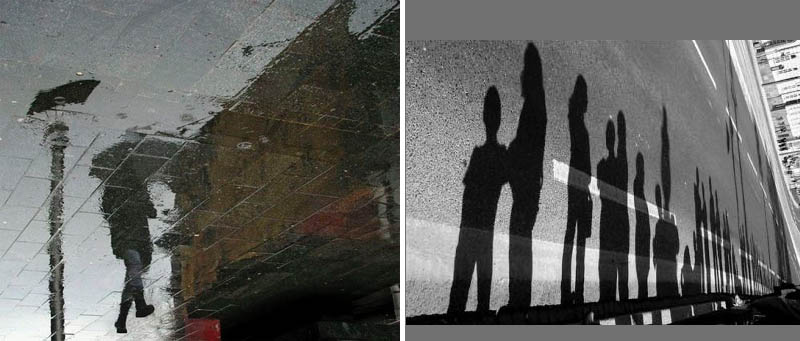
Again, sublime reflections and shadows - to fit every mood:
(originals unknown)
5. Impossible Architecture and Interior Design
"The Waterfall" falls firmly into the category of impossible sculptures, bringing to life the famous painting by M.C. Escher - see the original here. On the right is the same structure replicated in... LEGO (more info):


(images via 1, 2, 3, 4)
More mind-bending and surreal works by Escher:

(images via)
Another LEGO re-creation of M.C.Escher's stairs and labyrinthine rooms was made by Henry Lims:

(images credit: Henry Lims)
An impossible door (below right):

(images via)
6. Not what it seems! Masterpieces of 3D Street Pavement Art
Kurt Wenner is the foremost practitioner of this popular urban art subgenre. He paints epic, spiritual and inspiring 3D canvases on the humble street pavement, which fit perfectly in European cities, among Gothic cathedrals and gorgeous architecture:

("Dies Irae (Day of Wrath)" - images credit: Kurt Wenner)
J. Beever has accumulated quite a portfolio of street paintings over the years. They are dizzying, strange, often humorous... Again, these so called "anamorphic illusions" create an impression of three dimensions only when seen at a particular angle:


(images credit: J. Beever)

(left: Edgar Mueller; right: J. Beever)
The "Crevasse" (above left) may have been inspired by the art of Julian Beever, but it is an independent and astonishing work by German artist Edgar Mueller - see more examples here.

(art by: Edgar Mueller, via)
Illusory Photo Manipulation in Advertising
Sometimes a particular advertising campaign can turn scary, surprising our senses with a "floor-less" elevator, see below. Of course, it's only a trick painting on the elevator's floor...

Imagine trying to pass a truck like this on a highway... giving more space to that sticking out bottle, just in case:

It's easy to see why the paintings below are so unique. Guido Daniele paints on hands... other advertising also uses feet:


And finally, these are not illusions, but photo-manipulated and mind-bending "reality" nevertheless:


("Octopus", art by Leo Vilela; other images via John Lund)
Also Read: "OPTICAL ILLUSIONS IN ART"! ->

Mind-Bending Optical Illusions

martes, 7 de septiembre de 2010

Antibióticos de cucaracha

antibiotico-cucarachaLas cucarachas, insectos que la mayoría de la gente considera repulsivos, esconden en su cerebro hasta nueve moléculas a partir de las cuales podrían producirse antibióticos, según revela un estudio de la Universidad de Nottingham (Reino Unido) presentados en la última reunión de la Sociedad General de Microbiología.
Esas moléculas tienen la capacidad de combatir más del 90 por ciento de las cepas de bacterias resistentes como Staphilococcus aureus (causante de muchas intoxicaciones alimentarias) y Escherichia coli. Los científicos sospechan que, para sobrevivir en los ambientes insalubres en que se mueven, las cucarachas han desarrollado sofisticados mecanismos capaces de hacer frente a los microorganismos.
"En estos momentos estamos estudiando en el laboratorio las propiedades antibacterianas de estas moléculas y esperamos que puedan servir para desarrollar nuevos antibióticos eficaces contra estos patógenos", explicó Simon Lee, coautor del trabajo.

Antibióticos de cucaracha

lunes, 6 de septiembre de 2010

Jimmy Choo Bree Large Calf Hair Bag


Jimmy Choo Bree Calf Hair Handbag
A loud and proud bag that's great for daytime looks but isn't for the faint of heart, the Jimmy Choo Bree Large Calf Hair Bag comes in glossy brown leopard-print calf hair with cut-outs of gray leopard on the upper corners and plenty of goldtone-and-stud-enhanced buckles wrapping around either side. Other features include a detachable calf hair keyfob, double top handles long enough to go over the shoulder, two side pockets, top closure via twist-lock fastening strap, and a pale suede lined interior with zip and pouch pockets. A beautiful statement bag for fall and winter. $2,395

Jimmy Choo Bree Large Calf Hair Bag, Handbag of the Day  de Luxist de Rigel Celeste

sábado, 4 de septiembre de 2010

Monstruos marinos

"Why are the Earth's oceans more mysterious to us than the Moon?"

- Bill Bryson, "A Short History of Nearly Everything"
It's commonly said we know more about the surface of the moon than we know about what happens right here on our own planet, in that murky world at the bottom of the sea. And indeed, we have only explored less than 5 percent of our oceans (we have better maps of Mars than we do of the ocean floor!)

(The Iceland catshark, found off Greenland - image credit National Geographic)
Here's a fun fact for you: did you know that you, an unprotected human being, can last for about two whole minutes in a vacuum -- say on the surface of the moon? Here's another amusing bit of knowledge: did you also know that you, still just an unprotected homo sapiens, would last only the barest smidgen of a second before being totally, completely pulped by the crushing pressures at the bottom of the sea?
There is also more light on the dark side of the moon than there is down, down, down in those ocean depths... One thing we do know, though: even in the deepest part of the ocean, the Challenger Deep in the Mariana Trench, despite the crushing pressure (at least 16,000 pounds per square inch) and the absolute, total, complete darkness, there is life. Auguste Piccard, who made an adventurous trip in 1960 to the bottom of the Deep in his bathyscaphe, the Trieste, saw a few extreme creatures that managed to made that extreme environment their home.
The Fangtooth Fish lives at depths of more than 5,000 meters:


(Bottom: Pacific Viperfish & Vampire Squid - images credit: David Wrobel, National Geographic)
While not as deep – but just as dark – as the Deep, scientists have found, and continue to find, an amazing, and sometimes nightmarish, world of creatures in the abyssal plains, which make up more than a staggering 50% of the earth's surface.

(Black Dragonfish, image credit: Peter Shearer, National Institute of Water and Atmospheric Research)
Light is so rare down there that its uniqueness is an allure, for mating, as well as a lure, for eating. Grammatostomias flagellibarba, 'dragon fish' to you and I, uses bioluminescence – biological light – mainly for the latter: EATING. Any deep, deep, deep swimmer that notices and becomes interested in a certain tiny flickering light will end up becoming caught by the dragon fish's monstrously huge and needle-sharp toothed mouth. The light being a glowing lure at the end of a long, thin filament connected to the underside of the fish's jaw:

(Scaly Dragonfish, Stomias Boa, image credit: Edith Widder)
The sea angler uses a similar trick, though it's more globular instead of having the dragon fish's lean and nasty body. The angler's lure has the same function, but a different location: its flashing trick is a kind of deadly finger between its eyes and its similarly sharp-toothed mouth rather than being at the end of a thin strand like the dragon fish.
Found two kilometers beneath the Coral Sea, off the shores of Australia - the Hairy Anglerfish: "The long hairs of the anglerfish carry sensory information to the fish's brain":


(image credit: Queensland Brain Institute, via)
The "Longhead Dreamer" anglerfish (Chaenophryne longiceps) was found in waters near Greenland (more info):

(images credit: Peter Rask Møller, National Geographic)
The Bathysaurus, or deep sea lizardfish, can and will bite with any opportunity. It's also a half-a-meter long:


(left: snaggletooth fish; right: barreleye fish, images via 1, 2)
Yet another contender for the oddly pretty prize is the so-called barreleye. This fish takes vision to a new level of spooky strange. Sure, it has eyes, but instead of having to deal with an oh-so-annoying skull that gets in the way of what it's trying to see, the barreleye's head is transparent: to look up it just moves its eyes to focus through its clear – and a bit disturbing – cranium.

(image credit: National Geographic)
Atolla & Periphilla Jellyfish:

(images credit: Queensland Brain Institute, via)
A see-through sea cucumber, Enypniastes, was spotted at depths of about 1.7 miles (2.7 kilometers). It lives in the northern Gulf of Mexico, at depths of 2.7 kilometers (bottom left). On the right is "Dumbo" - with ridiculously big "ears":

(images credit: Census of Marine Life, via)
The Ping Pong Tree Sponge is one of the family of carnivorous demosponges (I bet you read "Demon-sponges, didn't you?) and is pretty big, at least half a meter in height... more info:

(left image credit: Claire Nouvian; right image via)
The granrojo (above right) is not hooked or spiked, but this deep-water jellyfish is just as odd, with chubby arms and an almost plastic looking crimson bell.
While neither of these fish and jellies – and there are far too many to name here – are monsters in size, there is something called abyssal gigantism, the tendency for other forms of extremely deep-dwelling organisms to not only be odd, strange, bizarre and darned creepy but also – yes, you guessed it – HUGE.
Do you have a small dog, a cat, or a larger-than-average tortoise? How would you like to have a pet the size of any of them but isn't just from a different species but from a whole different phylum?


(image via)
Cute? Not really. Cuddly? Absolutely not. But the giant isopod would certainly be a conversation starter if you took it out for a walk: imagine a pill bug weighing over four pounds.
Other abyssal giants include the poster child for arachnophobia, the Japanese spider crab, which averages 12 feet from leg to creepy leg; and then there's the giant ... well, we'll get to him in a minute.


(images via 1, 2)
Vampire Sea Spider from Antarctica? Sounds like something from H.P.Lovecraft's "At the Mountains of Madness", but it is a real creature, not a fantasy (more info) -

(image via)
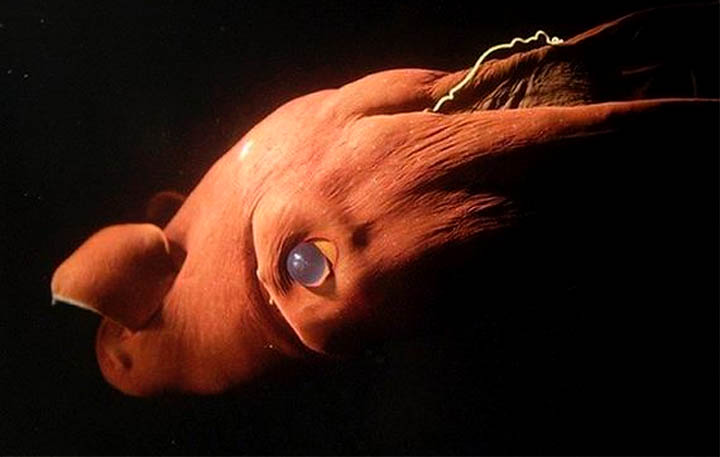
While not a heavyweight, one of the most oddly lovely creatures living in the dark depths is the very-correctly named vampire squid. Blood red, with soft hooks instead of a squid's regular suckers, it has the neat trick of flipping it's legs over its soft body turning itself into a spiny ball. The vamp has its own bioluminescent trick as well: glowing when it wants to be seen but turning its lights off when it wants to vanish into the darkness.


(images via 1; David Shale, 2)
We could go on, and there are certainly more than enough odd and strange and weird and beautiful and disturbing creatures out there, but it has to be mentioned that while we know about some, there are still possibly thousands of even odder, stranger, weirder, more beautiful and disturbing creatures in the deep seas.


(images via 1, 2; art by Bob Eggleton)
Remember the promise about getting back to one particular example of abyssal gigantism? Well, there is one creature that is a mix of the known and the unknown, exemplifying the wonder, and horror, of the dark oceans. For a long time it was thought it was just a myth, a story shared by sailors who'd been out at sea too long. But then there was evidence: the disturbing marks on the sides of Sperm Whales, the kings of the sea -- evidence of nightmarish battles between one and the other miles below the surface.

(images via 1, 2)
These giants are out there, possibly the largest species currently on the planet: eyes the size of dinner plates, 30 foot tentacles dotted with razor-toothed suckers, and a massively strong beak. Architeuthis, the giant squid to you and I, was recently filmed for the first time but there is still much – too much – we don't know about it.
So take a moment and look up at the stars and the moon, wonder about the mysteries that may be up there, but then go to the shore, look out at the sea, and think that we may very well know more about a hunk of rock 250,000 miles away than we know about a world full of life just a few miles away, and many lightless miles straight down.

Fuente: Dwellers In The Abyss: Ugly, Monstrous Fish